
Estrogen, Histamine and OmneDiem's Menopause Complete
Estrogen, Histamine & Your Hormonal Transitions: What Every Woman Should Know
Feeling more sensitive to certain foods during hormonal transitions? Noticing changes in flushing, temperature regulation, sleep, or everyday comfort at different points in your cycle or during perimenopause? The relationship between estrogen, progesterone, mast cells, and histamine metabolism is an important and often overlooked area of women’s wellness.
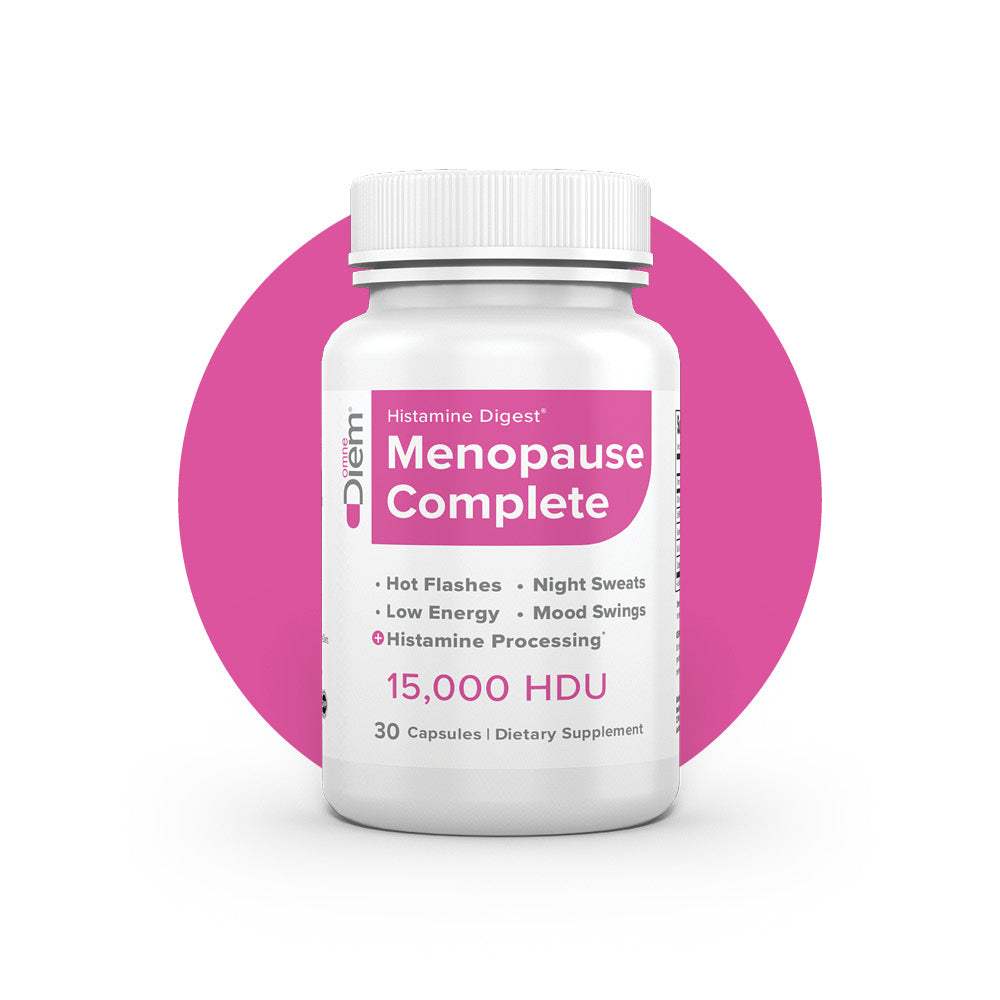
Menopause Complete with DAO Plus
Physician-formulated support for histamine metabolism, hormonal balance, and cognitive clarity — featuring 15,000 HDU of pharmaceutical-grade Diamine Oxidase (DAO), Estro8PN hops extract, flaxseed, black cohosh, and citicoline.*
Shop Menopause Complete →Does Estrogen Increase Histamine?
Research suggests it can. Estrogen stimulates mast cells — the immune cells that store and release histamine — and can increase histamine release throughout the body. At the same time, estrogen appears to downregulate diamine oxidase (DAO), the primary enzyme your gut uses to break histamine down.
The result is a double effect: more histamine released, less histamine cleared. And the relationship runs both ways — histamine can stimulate the ovaries to produce more estradiol, creating a self-reinforcing loop that many women experience as cyclical headaches, flushing, skin reactions, or anxiety that tracks with hormonal shifts.
Estrogen and Histamine: A Two-Way Relationship
Understanding estrogen and histamine as partners in a feedback loop explains why symptoms so often flare at predictable times:
| Life stage | What's happening hormonally | Common histamine-related experience |
|---|---|---|
| Ovulation & pre-period | Estrogen peaks or fluctuates sharply relative to progesterone | Headaches, hives, congestion, PMS-like flares |
| Pregnancy | Placenta produces large amounts of DAO | Many women's histamine symptoms temporarily improve |
| Perimenopause | Erratic estrogen swings, falling progesterone | New or worsening food sensitivities, flushing, insomnia |
| Menopause | Overall estrogen decline, but mast cells stay reactive | Hot flashes, night sweats, skin and gut reactivity |
Progesterone matters too: it tends to stabilize mast cells and support DAO activity. When progesterone falls faster than estrogen — the classic perimenopause pattern — the histamine "brakes" weaken just as the "accelerator" gets pressed.
Perimenopause Histamine Intolerance: Why Symptoms Often Start in Your 40s
Many women develop perimenopause histamine intolerance seemingly out of nowhere. Wine they've enjoyed for decades now causes flushing and palpitations. Aged cheese triggers headaches. Sleep falls apart. The reason is the hormonal signature of perimenopause itself:
- Estrogen swings wildly — spiking higher than in your 30s before crashing, over-stimulating mast cells with each surge.
- Progesterone declines first — removing its calming, DAO-supportive influence.
- DAO activity can drop — leaving dietary histamine (wine, cured meats, aged cheese, fermented foods, leftovers) less efficiently cleared.
Histamine Perimenopause Symptoms: A Quick Checklist
Histamine perimenopause overlap is easy to miss because the symptoms mimic each other. Signs your "menopause symptoms" may have a histamine dimension:
- Flushing or hot flashes that worsen after wine, aged cheese, or fermented foods
- New food sensitivities appearing in your 40s or 50s
- Itching, hives, or skin reactivity alongside hormonal symptoms
- Headaches or migraines that track with your cycle
- Nasal congestion, racing heart, or anxiety after histamine-rich meals
- Symptoms that flare mid-cycle or before your period
If several boxes ring true, a two-pronged approach — supporting hormonal balance and histamine breakdown — makes more sense than treating either alone.
Perimenopause Histamine Support: How Menopause Complete Works
Most menopause supplements address hormones. Most DAO supplements address histamine. OmneDiem's Menopause Complete with DAO Plus was formulated to address the perimenopause histamine connection from both directions in a single capsule:*
- 15,000 HDU pharmaceutical-grade DAO enzyme — clinically studied to support the breakdown of food-derived histamine in the gut, helping relieve symptoms associated with histamine intolerance.*
- Estro8PN hops extract, flaxseed lignans & black cohosh — botanicals traditionally used to promote estrogen balance and ease hot flashes, night sweats, and mood swings.*
- Citicoline — a clinically studied nootropic supporting focus, memory, and mental energy through the brain-fog years.*
The formula is non-GMO, gluten-free, soy-free, and free of unnecessary fillers.
FAQ
Does estrogen increase histamine directly?
Estrogen stimulates mast cells to release histamine and may reduce DAO activity, so higher or fluctuating estrogen levels are associated with a higher histamine load in sensitive women.
Why did my histamine intolerance start in perimenopause?
Erratic estrogen surges plus declining progesterone create the ideal conditions for histamine excess — more release, less breakdown. Many women first notice food reactions during this transition.
When should I take Menopause Complete?
Take as directed on the label, ideally shortly before meals, so that the DAO enzyme is available when dietary histamine is processed. Consult your healthcare provider before starting any new supplement.
Support Your Hormones and Your Histamine — Together
One capsule. 15,000 HDU of DAO, botanical hormone balance, and brain support for the transition years.*
Get Menopause Complete — $39.95Free shipping · Satisfaction guarantee · Subscribe & save 10%
Learn more about Menopause and Histamine Intolerance
*These statements have not been evaluated by the Food and Drug Administration. This product is not intended to diagnose, treat, cure, or prevent any disease. This content is for educational purposes only and is not a substitute for medical advice. Consult your healthcare provider, especially if you are pregnant, nursing, or taking medication.