
FAQ About DAO Enzyme Supplements
DAO Enzyme & Histamine Intolerance: Your Questions Answered
A plain-language guide to diamine oxidase (DAO), dietary histamine, and how OmneDiem's Histamine Digest DAO enzyme supplements support your body's own histamine-metabolizing pathway.
Educational disclaimer: This information is provided for educational purposes only and is not intended to be a substitute for professional medical advice, diagnosis, or treatment. Always seek the advice of your physician or another qualified health provider with any questions you may have about a medical condition or before beginning any new supplement. Never disregard professional medical advice, or delay seeking it, because of something you have read here.
On this page — jump to a topic
- Histamine intolerance is not a true allergy — it reflects a mismatch between dietary histamine coming in and the body's ability to break it down, often linked to low activity of the diamine oxidase (DAO) enzyme.[2]
- DAO is the main enzyme that degrades histamine in the digestive tract, and supplemental DAO acts locally in the gut rather than systemically.[4]
- How to use it: OmneDiem's Histamine Digest is taken 15–30 minutes before a meal so the enzyme is present as food is digested.
- Cofactors matter: nutrients such as vitamin C, vitamin B6, and copper participate in the body's normal DAO activity.[2]
Histamine intolerance, the basics
What is histamine intolerance?
Histamine intolerance isn't a true allergy — it's a condition in which the body has difficulty breaking down histamine from foods. This can happen when there is reduced activity of diamine oxidase (DAO), the enzyme responsible for degrading histamine in the gut. When DAO activity is low relative to histamine intake, histamine can accumulate, leading to symptoms that often resemble an allergic reaction.[2][1]
What are the common symptoms people associate with histamine intolerance?
Because histamine receptors are found throughout the body, associated symptoms can be wide-ranging. People commonly describe digestive discomfort such as bloating, abdominal pain, and diarrhea; skin responses such as hives or flushing; and other experiences like head discomfort, a stuffy or runny nose, and an irregular heartbeat. These typically appear shortly after consuming histamine-rich foods.[2] If you are experiencing symptoms, discuss them with a qualified healthcare professional.
What's the difference between a food allergy and a food intolerance?
This is a crucial distinction. A food allergy is an immune-system response: even a tiny amount can trigger a reaction that may be immediate and severe, potentially life-threatening (anaphylaxis). The body mistakenly identifies a harmless food protein as a threat. A food intolerance is a digestive-system issue that often relates to a specific enzyme (such as DAO for histamine, or lactase for lactose); symptoms are usually limited to digestive discomfort like gas and bloating and are not life-threatening.[1]
OmneDiem's Histamine Digest provides the enzyme diamine oxidase to support the normal metabolism of histamine from food. It has no impact on food allergies. If you suspect a true food allergy, seek immediate medical attention.
Is histamine intolerance the same as MCAS (Mast Cell Activation Syndrome)?
No — they are different. Histamine intolerance relates to breaking down histamine. MCAS is a disorder in which mast cells (which store and release histamine) are overactive, leading to excess release of histamine and other mediators. The symptoms can overlap, but the underlying mechanisms are distinct, and they are evaluated differently by clinicians.[7]
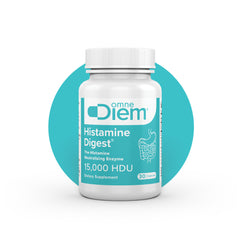
Histamine Digest — 15,000 HDU
An easy entry point into DAO enzyme support. Take before higher-histamine meals to support your body's natural histamine breakdown.
Shop the entry size →Understanding the DAO enzyme
Why might I consider a DAO supplement?
Your body naturally produces DAO, but various factors can reduce its activity, including genetics, certain medications, and gut-health issues. A DAO supplement supplies the same enzyme your gut uses to break down dietary histamine in the small intestine, supporting the body's normal handling of histamine from high-histamine foods and beverages.[3] Explore the full range of DAO enzyme supplements from OmneDiem.
What is HDU?
HDU stands for Histamine Digesting Unit, the recognized measure of the enzymatic activity of diamine oxidase. Enzymes are proteins that drive specific reactions; in the case of DAO, activity is quantified by its capacity to break down dietary histamine. A product's HDU count reflects the enzyme's activity and the amount of source material present during extraction.
What factors can influence my body's DAO activity?
Several factors can affect how much active DAO your body has available, including genetic predisposition (some people naturally produce less), certain medications, alcohol intake, and imbalances in gut health.[2]
How is a DAO supplement different from an antihistamine?
Antihistamines work by blocking histamine receptors so histamine can't trigger a response. A DAO supplement works differently: it provides the natural enzyme that breaks histamine down in the digestive tract, before it is absorbed. That makes it a non-systemic, gut-level approach that supports your body's own histamine-metabolizing process rather than blocking receptors.[4]
Histamine in foods
What's the difference between dietary and environmental histamine?
Dietary histamine is the histamine naturally present in foods and beverages — especially aged, fermented, or cured items. Environmental histamine is produced inside the body by the immune system in response to triggers like pollen or dust. In short: dietary histamine is ingested, while environmental histamine is generated internally.[1]
Which foods are high in histamine?
Histamine is common in foods that are fermented, cured, or aged. Frequently cited high-histamine foods include:
[2] Individual tolerance varies; a healthcare professional or dietitian can help you personalize an approach.
What's the difference between a high-histamine food and a histamine-releasing food?
A high-histamine food directly contains large amounts of histamine (e.g., aged cheese). A histamine-releasing food doesn't contain much histamine itself but may prompt the body to release its own stored histamine — examples often mentioned include citrus fruits and chocolate.
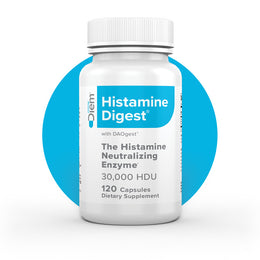
Histamine Digest — 30,000 HDU
Everyday DAO enzyme support at a higher activity level for regular high-histamine meals.
Shop 30,000 HDU →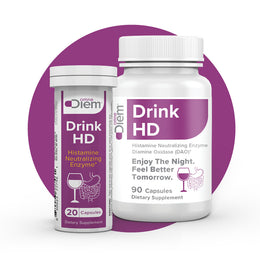
Drink HD — DAO Enzyme Drink
A convenient drinkable format of diamine oxidase for support wherever your day takes you.
Shop Drink HD →Using OmneDiem Histamine Digest
How and when should I take Histamine Digest?
For best results, take OmneDiem's Histamine Digest 15–30 minutes before a meal or beverage. This timing helps ensure the DAO enzyme is present in your digestive tract, ready to support the natural breakdown of histamine from the food you're about to eat.[3]
How long will one bottle last?
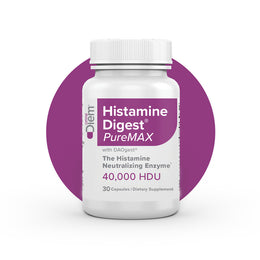
Histamine Digest comes in three sizes and strengths: a 15,000 HDU 30-count bottle, a 30,000 HDU 60- or 120-count bottle, and a 40,000 HDU 60-count bottle. Depending on whether you take it daily or only before high-histamine meals, a bottle can last from about one to three months.
Can I open the capsule and mix the powder with food or a drink?
We don't recommend opening the capsule. The capsules are specifically designed to protect the delicate DAO enzyme from stomach acid so it can reach the small intestine, where it does its work.
Can I take Histamine Digest with other supplements or medications?
It is generally compatible with most other supplements. Because certain prescription drugs can affect DAO activity, it's always best to check with your doctor or a qualified healthcare professional before combining it with prescription medications.
Is Histamine Digest suitable for daily, long-term use?
DAO is a natural compound in your body that supports the breakdown of histamine from food, and Histamine Digest provides supplemental DAO that works locally in the digestive tract rather than systemically. It is well tolerated when used as directed.[3] As with any supplement, consult your healthcare professional before beginning a new regimen.
Can I take Histamine Digest while pregnant or breastfeeding?
We advise against using any supplement during pregnancy or breastfeeding without first consulting your doctor. Please seek professional medical advice before taking any new supplement during this important stage.
What if I'm not satisfied with my results?
Histamine Digest is designed to support the body's natural histamine response, and individual experiences can vary. We always recommend discussing your individual health needs with a healthcare professional, and you're welcome to contact the OmneDiem team with questions.
Sourcing & quality
Why is OmneDiem's DAO from a porcine source, and why not a vegan DAO?
OmneDiem's Histamine Digest is formulated with a well-researched porcine-derived DAO enzyme (from porcine kidney protein extract). We chose this source for its long history of use in supplements, its well-established safety profile, and its enzymatic stability and histamine-degrading activity.[6] While some plant-based DAO options exist (often from pea sprouts), the porcine source is a well-studied, biologically active form of the enzyme, which lets us deliver a consistent, stable dose in every capsule.
Is Histamine Digest gluten-free and non-GMO?
Yes — Histamine Digest is both gluten-free and non-GMO. We prioritize high-quality, pure ingredients so the supplement suits as many people as possible.
Testing & supporting DAO naturally
How do I know if I have low DAO activity?
If you suspect histamine intolerance, it's best to consult a healthcare professional. They may suggest an elimination approach to observe whether your symptoms change.[5]
How is histamine intolerance evaluated?
There isn't a single definitive test. A healthcare provider might use a histamine elimination diet to see whether symptoms improve, and may consider a DAO serum test to look at enzyme activity or a histamine blood test.[8][5] Interpretation should always be done with a qualified professional.
How can I support my body's natural DAO activity?
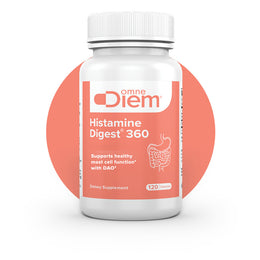
Certain nutrients — including vitamin C, vitamin B6, and copper — participate in the body's normal production and function of DAO. A diet built around fresh, non-fermented foods can also help support healthy histamine levels, and some people add a DAO supplement for extra enzymatic support with dietary histamine.[2][1] OmneDiem's Histamine Digest 360 pairs DAO with vitamin B6 (as P5P).
How do probiotics fit into a healthy histamine response?
Maintaining a balanced gut microbiome is one part of overall wellness. Some people find that specific probiotic strains support this balance. Because different strains serve different purposes, it helps to choose strains researched for gut health and a balanced histamine response — you can explore OmneDiem's probiotics to learn more.
Find the right DAO enzyme support for you
Every OmneDiem DAO product supplies diamine oxidase to support your body's natural breakdown of dietary histamine. Browse the complete DAO enzyme collection, or start with a favorite below.
Related resources
 DAO Enzyme Collection
Shop all Histamine Digest options
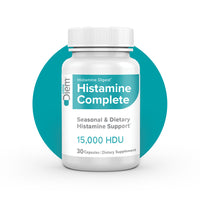
Histamine Complete
Seasonal & dietary histamine support
DAO Enzyme Collection
Shop all Histamine Digest options
Histamine Complete
Seasonal & dietary histamine support
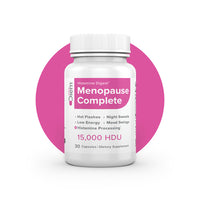 Menopause Complete with DAO
Menopause support that includes DAO
Menopause Complete with DAO
Menopause support that includes DAO
 Probiotics
Support a balanced gut microbiome
Amazon Listings
Shop OmneDiem on Amazon
Contact Us
Questions? Our team can help
Probiotics
Support a balanced gut microbiome
Amazon Listings
Shop OmneDiem on Amazon
Contact Us
Questions? Our team can help
Scientific references
The following peer-reviewed and government-hosted sources provide background on histamine, diamine oxidase, and related science. They are provided for education and do not constitute medical advice or claims about any product.
- [1] Maintz L, Novak N. Histamine and histamine intolerance. The American Journal of Clinical Nutrition, 2007. PubMed (NIH)
- [2] Comas-Basté O, et al. Histamine Intolerance: The Current State of the Art. Biomolecules, 2020. PMC (NIH)
- [3] Schnedl WJ, et al. Diamine oxidase supplementation improves symptoms in patients with histamine intolerance. 2019. PMC (NIH)
- [4] Toward Oral Supplementation of Diamine Oxidase for the Treatment of Histamine Intolerance. Nutrients, 2022. PMC (NIH)
- [5] Serum diamine oxidase activity in patients with histamine intolerance. 2018. PMC (NIH)
- [6] The Rate of Histamine Degradation by Diamine Oxidase Is Compromised by Other Biogenic Amines. 2022. PMC (NIH)
- [7] Comparing histamine intolerance and non-clonal mast cell activation syndrome. 2020. PMC (NIH)
- [8] Basal Serum Diamine Oxidase Levels as a Biomarker of Histamine Intolerance: A Retrospective Cohort Study. Nutrients, 2022. PubMed (NIH)
*These statements have not been evaluated by the Food and Drug Administration. This product is not intended to diagnose, treat, cure, or prevent any disease.
OmneDiem products are dietary supplements intended to support the body's normal structure and function. They are not intended to diagnose, treat, cure, or prevent any disease or medical condition. Always consult a qualified healthcare professional before starting any supplement, especially if you are pregnant, nursing, taking medication, or managing a health condition.
↑ Back to top